
From 31 October officers decide most Horsham planning applications. Eight objections or a councillor's request will no longer guarantee a committee hearing.
Fewer planning applications in Horsham district will be decided by councillors in public from 31 October. A new national scheme of delegation takes effect that day. It hands most decisions to council officers and sets a high bar for any application to reach the Planning Committee.
Horsham District Council has rewritten its constitution to comply. Full Council is asked on Wednesday 7 October to adopt the new version, with effect from 14 October. The Governance Committee recommended it on 28 September.
What the new law says
The rules come from the Town and Country Planning (Discharge of Local Planning Authority Functions) (England) Regulations 2026. The council’s report to the Governance Committee explains that they split applications into three groups:
- Schedule 1: householder applications, prior approvals and many minor developments. These must be decided by officers. They cannot go to committee.
- Schedule 2: typically larger, strategic or more sensitive schemes. These can go to committee, but only in limited circumstances.
- Own interest: applications made by the council, a councillor or a council officer, or ones in which the council otherwise has an interest.
The report says the statutory guidance sets “a clear presumption” that even Schedule 2 applications are decided by officers. Referral to committee should happen “in only exceptional circumstances”.
The guidance also rules out two habits many councils rely on. The report quotes it directly: ward councillors requiring a case to be called in, and “trigger points for referral to committee if a certain number of objections is reached, will not be possible.”
Three gateways to the committee
Horsham’s answer is a three-stage test. An application has to pass all three to be heard by councillors.
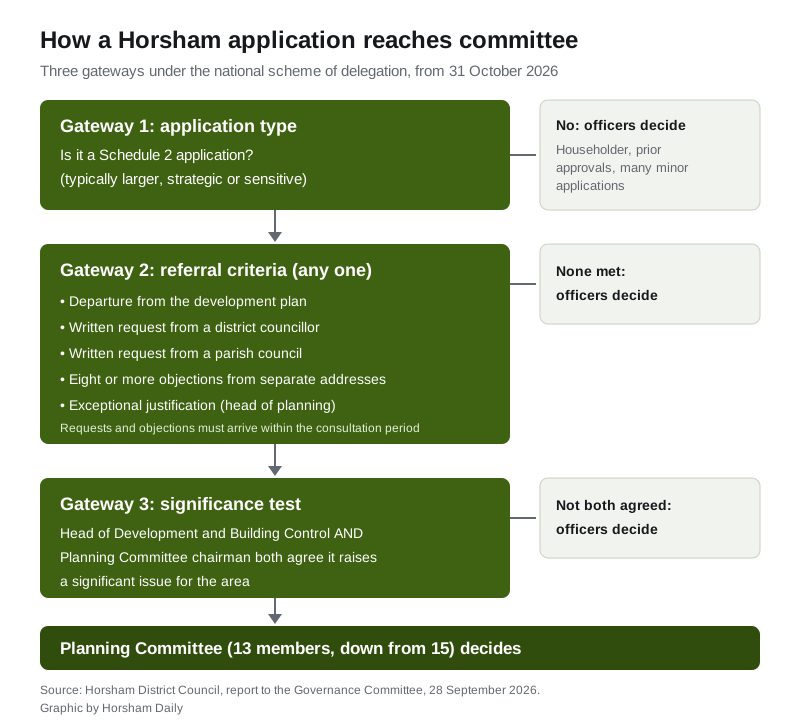
Gateway 1 asks whether it is a Schedule 1 or Schedule 2 application. Only Schedule 2 goes further.
Gateway 2 checks it against the council’s referral criteria. The report says these “broadly reflect” Horsham’s existing arrangements. One is enough:
- the application is a departure from the development plan
- a district councillor asks for it to go to committee, in writing, within the consultation period, explaining why it is significant
- a parish council asks the same, in writing and in time, and wishes to address the committee
- eight or more written objections arrive from separate addresses or bodies within the consultation period (a parish council’s objection does not count towards the eight)
- the Head of Development and Building Control sees exceptional justification
Gateway 3 is the new hurdle. A Nominated Officer and a Nominated Member must both agree that the application raises an issue of economic, social or environmental significance to the area, or a significant planning matter. Horsham proposes the Head of Development and Building Control as the officer and the Planning Committee chairman as the member. If they do not both agree, officers decide it.
Own-interest applications skip the first two gateways. The same officer and member consider every one of them for referral.
A smaller committee
The regulations cap planning committees at 13 members, according to the report. Horsham’s has 15, so it shrinks to 13. The pool of substitute councillors falls from up to 15 to up to 9, which the report says will help keep every substitute trained.
Other changes in the schedule of amendments:
- Committee members may not move or second motions on applications in their own ward. They already could not vote on them.
- A ward councillor who is not on the committee speaks once, as a local representative, from a separate speaking area. They cannot put forward or support an alternative motion.
- Ward councillors may send a written statement of up to 750 words instead of attending.
- Full Council loses its power to decide planning applications and appeals referred up to it.
What it means for you
If you are objecting to a planning application, or supporting one:
- Timing now matters more. Councillor requests, parish council requests and the eight objections all have to arrive within the consultation period. That means the first one, or a later one triggered by a new site notice, press notice or neighbour letter.
- A householder application will never go to committee. An extension, a loft conversion or a garage next door is decided by an officer.
- Eight objections open the door, they do not guarantee a hearing. Only the officer and the chairman, together, can send an application to committee.
- You can write instead of speaking. Members of the public may send a statement of up to 450 words instead of taking a speaking slot. Parish councils get 750 words. Statements go to committeeservices@horsham.gov.uk by noon two working days before the meeting, and must carry the writer’s name, according to the draft constitution.
- Speaking slots are unchanged. Up to three objectors and three supporters get three minutes each, and a parish council gets five.
To see what has been submitted near you, use our guide to Horsham planning applications, which explains how to search the council’s register and comment.
What happens next
Full Council meets at 6pm on Wednesday 7 October in the Council Chamber at Albery House. The report says training for councillors and officers will follow. A separate implementation policy will guide the officer and the chairman on what counts as significant. The council says it will update that policy from time to time with the Cabinet Member for Planning and Infrastructure.
Have your say