

Horsham recycled 62.2% of household waste once weekly food rounds began, beating its 55% target. Missed bins have halved; soft plastics wait until 2030.
Horsham district recycled 62.2% of its household waste between April and June, the first months with weekly food waste collections at every address. That is well above the council’s 55% target.
The figure is in Horsham District Council’s performance report for July to September, which councillors on the Finance and Performance scrutiny committee looked at on Monday 2 November (Performance Report Quarter 2 2026/27). The recycling rate is always reported one quarter behind, so the April to June number is the latest.
What the report shows
- Recycling rate: 62.2% for April to June 2026, against a 55% target. The report says this is around 9.3% higher than the same quarter last year, and 15.5% up on January to March.
- Food waste: about 14% of everything recycled. The last food waste round started on 17 April 2026, which completed the district-wide rollout on time.
- Rubbish in the general waste bin: household waste volumes fell by 20.25% in July to September compared with the same period in an earlier year, beating a 10% target. That was up from a 19.74% fall in April to June. The measure’s title compares with 2025/26, while the commentary says 2024/25.
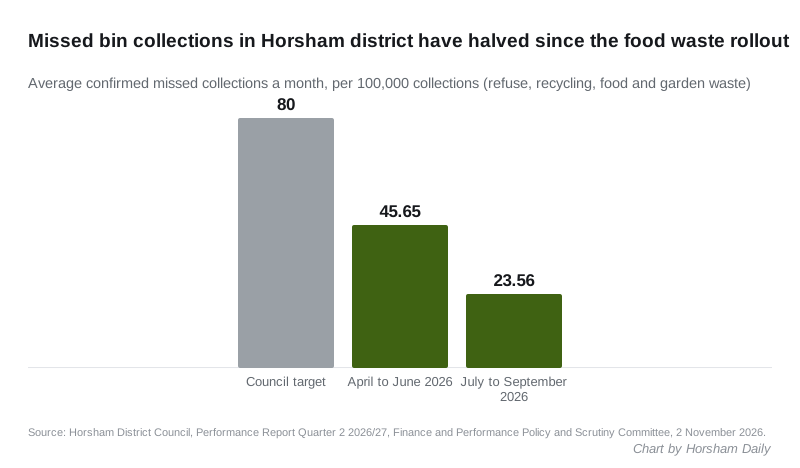
- Missed bins: an average of 23.56 confirmed missed collections a month per 100,000 in July to September. That is down from 45.65 in April to June and far inside the target of 80.
The report credits the food waste service and “continued engagement from residents since its implementation”. It also notes that the number of collections has risen sharply because of the extra weekly round, so the missed-bin rate is falling while the crews do more.
Soft plastics: not coming yet
One plan has been dropped for now. The council had aimed to start collecting soft plastics, such as carrier bags and food wrapping, by March 2027. That action is now marked closed.
The report explains why. The council was waiting for West Sussex County Council, which handles the district’s recycling once it is collected, to say how flexible plastics could be processed. The county was in turn waiting for the government, because there is no reliable market for the material yet.
On 17 July 2026, a Defra director wrote to the council’s chief executive. The letter set out the government’s intention to defer the requirement for councils in England to collect plastic film from households until 1 April 2030.
The money side
The waste service is not only cutting rubbish. The council’s mid-year budget monitoring says waste and recycling received £0.15m more than budgeted, as a payment because there is no waste transfer station in the district (Q2 finance and performance report). It also expects lower vehicle repair costs now that new lorries have arrived. Extra staffing costs are forecast to cover bank holiday overpayments.
The fleet remains a pressure. The council is about to replace nine more lorries after a 2022 refurbishment failed, as we reported in Horsham’s nine new bin lorries.
What it means for you
- Keep using the food caddy. It is doing most of the work behind the jump in the recycling rate. Food waste goes out every week on the same day as your other bin; check your dates on our Horsham bin collection days page.
- Keep plastic film out of the recycling bin. Bags, wrappers and crisp packets still are not accepted at the kerbside, and that is unlikely to change before 2030.
- If your bin is missed, report it to the council. The figure above counts only confirmed missed collections.
Sources
- Horsham District Council, Performance Report Quarter 2 2026/27, Appendix D to the report below
- Report on the Council’s Finance and Performance in Q2 2026/27, Finance and Performance Policy and Scrutiny Committee, 2 November 2026
Have your say