
Horsham District Council wants views on merging Horsham Town Council and North Horsham Parish Council into one 25-seat council. Both options ward by ward, and how to respond by 7 September.
Horsham and North Horsham could be run by a single town council. Horsham District Council’s draft recommendations from its district-wide Community Governance Review put two options to residents: merge Horsham Town Council and North Horsham Parish Council into one enlarged Horsham Town Council of 25 councillors, or keep both councils and redraw the line between them. The consultation runs until 11.59pm on Monday 7 September 2026 (consultation page; draft recommendations, PDF).
Whichever option wins, the review proposes that the whole of the Mowbray development north of the A264 sits inside one parish, ending its split between North Horsham and Rusper, and that Kilnwood Vale becomes its own neighbourhood council with 12 councillors, leaving a renamed Colgate and Faygate Parish Council behind. Elsewhere in the district the draft moves the whole of Small Dole into Upper Beeding, Rowhook into Warnham, Monks Gate into Nuthurst, and pushes Southwater’s boundary south into Shipley to take in the new estates.
Why this is being asked now
A Community Governance Review is the legal process by which a district council can create, merge, abolish or re-ward parishes. Horsham’s began in February 2026, its first consultation ran from 8 May to 22 June, and the Governance Committee agreed the draft recommendations on 22 July (review page). The council’s chief executive, Jane Eaton, said it had been 13 years since the last review and that “new housing developments, population growth and longstanding boundary anomalies can all affect whether current parish arrangements remain appropriate” (HDC, 24 July 2026).
The evidence the district cites for a Horsham merger came mostly from the town’s own responses. In Horsham, 21 of 39 online respondents said the current parish boundary did not reflect community identity, and 17 of those wanted a merger with a neighbouring parish. Horsham Town Council itself supported exploring a unified council. A group submission from elected representatives argued a merged authority could have around £1 million a year of income, cut duplicated staffing, use Millennium Hall as its offices, and give the town “strong leadership and representation after Local Government Reorganisation” (draft recommendations, pages 26 to 28). In North Horsham, the report says, opinion was “more evenly divided”.
Option 1: one Horsham Town Council, 25 seats, six wards
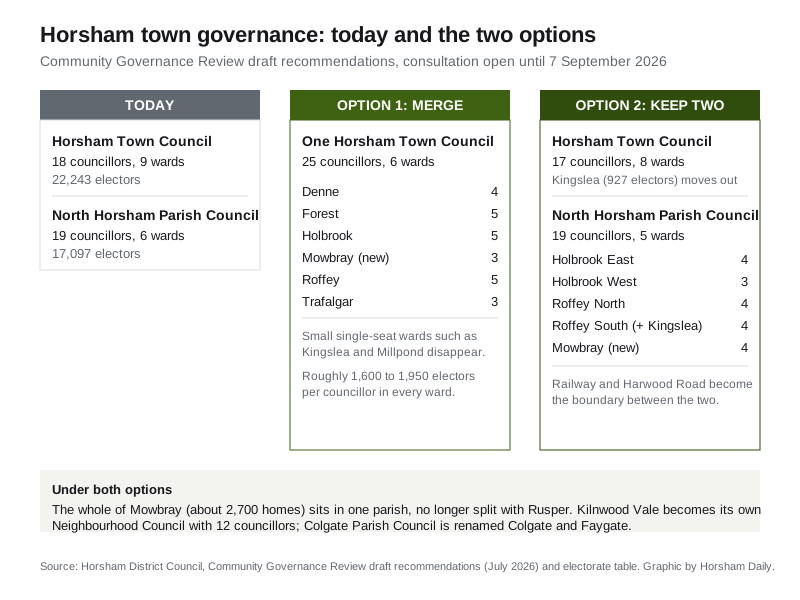
Today the two councils have 37 councillors between them: Horsham Town Council has 18 across nine wards for 22,243 electors, and North Horsham Parish Council 19 across six wards for 17,097 (electorate table). Several respondents said simply adding those together would produce an unwieldy body, and the draft settles on 25 seats, a figure the report says is supported by responses noting that other large town councils tend to have about that number.
The proposed wards, with seats and July 2026 electorates:
- Denne, 4 councillors: Denne, Blackbridge, Highwood, Collyers and Horsham Park polling districts, 7,473 electors, about 1,868 per councillor.
- Forest, 5: Forest, Chesworth, Millais, Oakhill, New Street, Pollards and Station Road, 8,250 electors, about 1,650 each.
- Holbrook, 5: North Heath Copse, Holbrook West, Millpond, Motte and Bailey, Holbrook East, 8,625 electors, about 1,725 each.
- Mowbray, 3: the North Horsham Rural polling district, 521 electors today but forecast to reach 5,407 as the estate builds out, about 1,768 each on the forecast.
- Roffey, 5: Roffey North, Littlehaven, Comptons, Foundry, Roffey South, 9,780 electors, about 1,956 each.
- Trafalgar, 3: Trafalgar and Greenway, 4,788 electors, about 1,596 each.
The pattern deliberately removes the small single-member wards such as Kingslea and Millpond, which councillors’ submissions quoted in the report describe as a by-product of the previous review having to respect county divisions and “too small to have meaningful geographic identity” in a built-up town.
Option 2: two councils, Kingslea moves north
The alternative keeps Horsham Town Council and North Horsham Parish Council as separate authorities but moves the Kingslea ward (927 electors) out of Horsham Town Council and into a new, enlarged Roffey South ward of North Horsham, so that the railway and Harwood Road become the boundary. North Horsham would be re-warded into five wards with 19 councillors: Holbrook East 4, Holbrook West 3, Roffey North 4, Roffey South 4 and a new Mowbray ward of 4. Horsham Town Council would drop to 17 councillors across eight wards, from Chesworth and Oakhill (3) and Trafalgar (3) down to single seats in Horsham Park and Millpond (proposed councillor table).
Mowbray, Kilnwood Vale and a proposal that was dropped
Mowbray is described in the evidence as one planned community of around 2,700 homes and a business park, currently divided between North Horsham and Rusper, with the area including Bohunt School on the Rusper side. Under both options the whole estate goes into the Horsham side of the line, with the parish boundary moving from Rusper Road to Northlands Road, formerly Old Holbrook Lane; the report says only one further property, Hill Top Farm, would move from Rusper as a result. A suggestion that Mowbray join Rusper instead is rejected as “not supported”: Rusper had no online responses as a primary parish.
Kilnwood Vale, some 2,500 to 2,650 homes split between Colgate and Rusper, would become an unwarded Kilnwood Vale Neighbourhood Council with 12 councillors. All three Colgate online respondents and Colgate Parish Council itself backed the split, and the report notes residents there pay both a management charge for communal assets and a parish precept.
One idea did not survive the Governance Committee. Officers had floated moving Denne Hill and Tower Park, 181 properties currently in Southwater parish but oriented towards Horsham, into whatever the town council becomes, with the A24 as the new boundary. The report records that “following discussion at the Governance Committee meeting on 22 July, particularly in relation to community identity, this proposal has been removed from the draft recommendations”. A merger of Broadbridge Heath into Horsham was likewise ruled out for lack of evidence, with the A24 treated as a clear physical boundary.
The rest of the district
- Bramber and Steyning: Bramber’s boundary extended to take in the whole of Bramber Brooks nature reserve.
- Broadbridge Heath and Slinfold: Broadbridge Heath extended west into the development land at Lower Broadbridge Farm and east of the River Arun, currently in Slinfold.
- Henfield and Upper Beeding: the whole of Small Dole into Upper Beeding, which would be renamed “Upper Beeding and Small Dole” with 13 councillors (three for Small Dole, ten for Upper Beeding); Henfield loses its wards but keeps its councillor numbers.
- Nuthurst, Lower Beeding and Cowfold: the whole of Monks Gate into Nuthurst, and a possible north/south split of Nuthurst into two wards of seven and four seats, on which the report explicitly wants more views because a plurality of Nuthurst respondents opposed warding.
- Rudgwick and Warnham: most of Rowhook into Warnham; councillor numbers unchanged.
- Southwater, Shipley, Thakeham and West Grinstead: Southwater extended south into the Rascals Farm and Woodfords development areas, re-warded into North (4), Central (6) and South (5); Dial Post west of the A24 into Shipley; the “Thakeham Finger” possibly into Shipley, with a boundary just south of Sproutes Lane.
- No change recommended for Parham, Amberley, Coldwaltham, Storrington and Sullington (whose parish council asked for the whole review to be delayed because of local government reorganisation), and the other parishes not listed above.
What it means for you
- Your parish precept and who you vote for. A merged Horsham council would set one precept across the town and North Horsham; the group submission’s case rests on pooling roughly £1 million of income and cutting duplicated overheads, but the draft does not publish a precept comparison, so ask for one in your response if it matters to you.
- If you live in Kingslea, you change parish under either option: into the enlarged town council under Option 1, into North Horsham under Option 2.
- If you live on Mowbray or in Kilnwood Vale, the review is the moment your estate stops being split between two parish councils. Both are described as anomalies to fix regardless of the Horsham decision.
- How to respond by 7 September: the online survey is at online1.snapsurveys.com/CommunityGovernanceReview2026Stage2; you can call 01403 215465, or collect a paper form from Albery House, Springfield Road, RH12 2GB, and return it to “Horsham CGR Consultation, Democratic Services” at the same address. Maps of every proposed change are on the council’s review page.
- What happens next: the Governance Committee will weigh the responses against the tests in the Local Government and Public Involvement in Health Act 2007 and produce final recommendations. The draft does not give a date for the final decision or for when any new arrangements would take effect; we will report it when the committee’s papers are published.
How parish precepts feed into your bill is explained on our council tax page; the district’s wider housing growth, which is what is stretching these boundaries, is on our planning news page.
Have your say