
Storrington NO2 is under the legal limit at every site for a second year, so the council expects to lift its 2010 pollution zone. Cabinet votes 23 September.
Nitrogen dioxide in Storrington has fallen below the legal limit at every monitoring site for a second year running, and Horsham District Council now expects to scrap the air quality management area it declared over the village in 2010.
That is the headline of the council’s new Air Quality Action Plan 2026-2031, which goes to the Communities and Place Policy and Scrutiny Committee at 5.30pm on Tuesday 15 September and then to Cabinet for approval on 23 September (committee agenda; cover report, PDF).
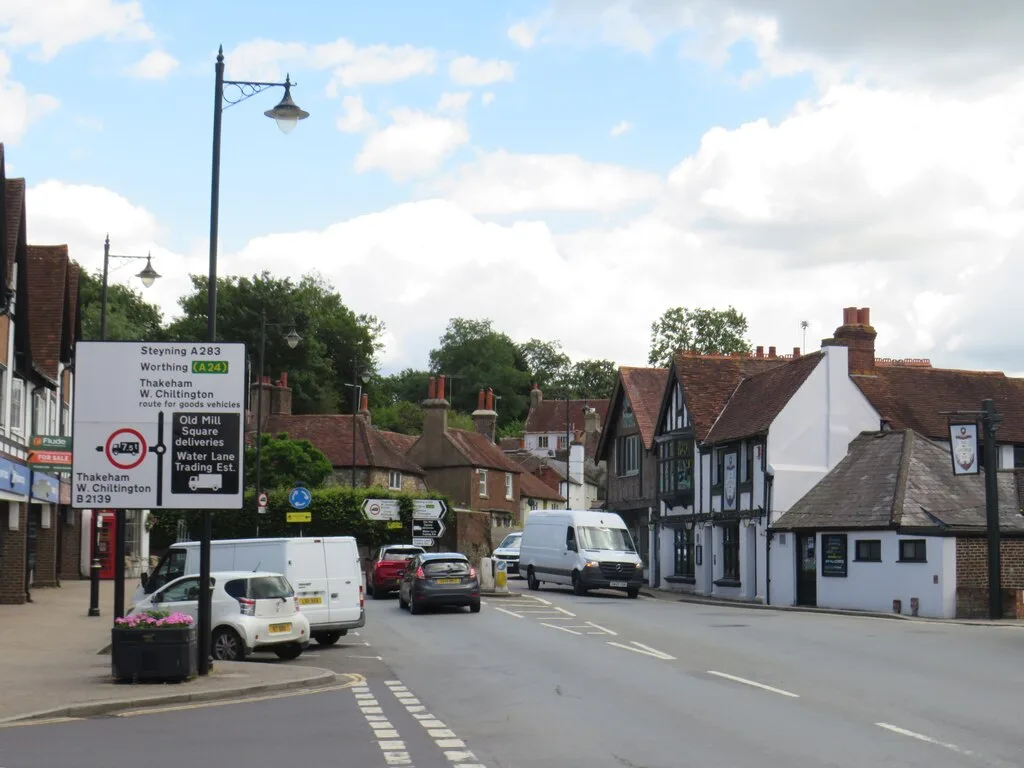
Storrington sits about eleven miles south of Horsham town, on the A283 under the South Downs. It has carried a legal pollution designation for nearly sixteen years.
What the figures now say
The air quality management area, or AQMA, was declared on 1 December 2010 for breaching the annual mean objective for nitrogen dioxide. It covers Storrington town centre: West Street, the High Street, and part of School Hill and Manley’s Hill.
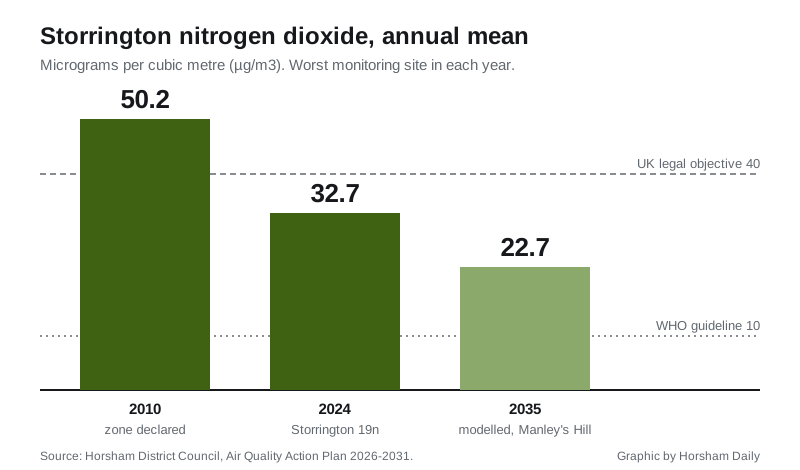
The legal objective is 40 micrograms of NO2 per cubic metre, averaged over a year. The numbers in the plan are these (Air Quality Action Plan 2026-2031, PDF):
- At declaration in 2010, the worst site read 50.2 µg/m3.
- In 2024, the worst site read 32.7 µg/m3, at the monitor known as Storrington 19n.
- The AQMA has now been compliant for two years, 2024 and 2025.
- Individual monitoring points have recorded falls of up to 48% since 2010.
There are 16 diffusion tubes around Storrington, eight of them inside the AQMA. Until recently one site kept the village on the wrong side of the line. Storrington 19n, at the mini roundabout where Manley’s Hill meets School Hill, had been within 10% of the objective, above 36 µg/m3, every year since 2019. In 2024 it dropped out of that band, and the plan records that year as “the first recorded year of full compliance across all monitoring locations”.
The council has done this once already in the district. The Cowfold AQMA was revoked in February 2026 after five years of compliance, leaving Storrington as the only one left in Horsham district.
The traffic did not go away
The obvious explanation would be that fewer vehicles now drive through Storrington. The council’s own traffic counter says otherwise.
West Sussex County Council runs a permanent counter on the A283 West Street, at the exit of Rectory Road. Comparing an average weekday in 2010 with one in 2024:
| Vehicle type | 2010 | 2024 |
|---|---|---|
| Cars | 15,670 | 16,411 |
| Light goods vehicles | 1,611 | 2,081 |
| Rigid HGVs | 347 | 292 |
| Articulated HGVs | 85 | 56 |
| Buses and minibuses | 73 | 83 |
| Motorcycles | 156 | 108 |
More cars, considerably more vans, fewer lorries. The improvement has come from what those vehicles emit rather than how many of them there are, and the plan is blunt that this will keep doing most of the work: its modelling found that “even substantial local measures are likely to have relatively modest impacts when compared with the reductions expected from natural fleet evolution”.
Road traffic accounts for 79% of the NO2 measured inside the AQMA. A large share of it is not local. The plan says drivers heading east to west to avoid congestion on the A27 through Lancing, Worthing and Arundel contribute roughly a third of the road-related pollution in the AQMA, and about half of it along Amberley Road.
The weight limit that is hard to enforce
A 7.5 tonne weight restriction has applied to the B2139 School Hill and the A283 Manley’s Hill since 2019, one of the original measures aimed at the AQMA. It is signed “Except for Access”, which the plan explains means side road access, a delivery or a collection between the signs.
Roughly 350 HGVs a day still used West Street on an average weekday in 2024, though the plan notes it is not known how many were serving local needs.
In 2022 West Sussex County Council and Storrington & Sullington Parish Council reviewed the restriction, ran a CCTV survey and sent 51 letters to companies found to be breaching it. In 2025 the council commissioned Air Quality Consultants to study Storrington, partly to check compliance. That study found 16 vehicles a weekday breaching the School Hill weight limit, most of them travelling uphill, with far fewer at weekends.
Enforcement is the problem. West Sussex has adopted the “Part 6” moving traffic powers that would let it fine drivers for breaches like this, but the plan says the county is currently using them only for bus gates, and will not extend them to weight restrictions until it adopts a Moving Traffic Enforcement Policy. There is no confirmed timetable for that policy.
An earlier idea went nowhere. A low emission zone was trialled with cameras on Pulborough Road, Amberley Road, Washington Road and School Hill, and was found not to suit a rural setting because of problems collecting usable data, on top of unresolved questions about management, enforcement and exemptions.
Legal is not the same as clean
The plan is careful not to declare the job done, and residents should read the compliance figure the same way.
The UK objective of 40 µg/m3 was set more than 25 years ago. The World Health Organization guideline is 10 µg/m3, and Storrington is well above that. Modelling for 2035, which assumes the vehicle fleet turns over normally, puts every modelled location below 20 µg/m3 except the bottom of Manley’s Hill, the current hotspot, at 22.7 µg/m3.
The council also says it could technically revoke the West Street and High Street part of the AQMA now, since that stretch has been compliant for several years. It is not proposing to, on the grounds that work to cut traffic and congestion on the High Street benefits the whole zone. The boundary stays as it is for now.
What the plan actually commits to
The measures listed for Storrington and the wider district are mostly about traffic and travel choice:
- speed reduction schemes in Storrington
- walking, wheeling and cycling measures
- better bus services and information
- support for car sharing and car clubs
- a Storrington community minibus
- a walk to school and active travel push in Storrington
The consultation ran from 26 May to 20 July 2026 and drew 225 survey responses and nine emails. Residents made up 94% of respondents and around 60% live in Storrington.
Twenty mile an hour limits came up repeatedly, and the council uses the plan to answer the objections. It accepts that dropping from 30 to 20 may not by itself deliver a substantial air quality improvement, but says studies generally find no deterioration either, and that smoother driving can give modest emissions benefits alongside the established road safety case.
One disclosure worth noting: the cover report states that it was prepared with the support of artificial intelligence tools, and that all content was reviewed and approved by the report author.
What it means for you
If you live in Storrington, the practical change is that the legal designation over your village is likely to be removed at some point before 2031, though the council stresses it depends on the readings staying where they are. Removing an AQMA does not remove monitoring: progress is reported every year through the Air Quality Annual Status Report to DEFRA.
If you drive a lorry through School Hill or Manley’s Hill, the 7.5 tonne restriction still applies and is still only lawfully avoidable for access. Enforcement powers are coming, without a date. Current closures and diversions on the A283 and elsewhere in the district are on our Horsham roadworks and travel page.
If you want to say something before it is adopted, the scrutiny committee meets at 5.30pm on Tuesday 15 September at Albery House, Springfield Road, Horsham, and Cabinet takes the decision on 23 September. Committee Services can be reached on 01403 215465.
The plan will be delivered by the Air Quality Steering Group, which brings together councillors and officers from Horsham District Council and West Sussex County Council with representatives of Storrington Parish Council, and meets about twice a year. The named officers on the report are Isabelle Carter, Scientific Officer, and Thais Covre Delboni, Environmental Protection Officer.
Sources
- Horsham District Council, Communities and Place Policy and Scrutiny Committee agenda, 15 September 2026
- Horsham District Council, Air Quality Action Plan report to Cabinet, 23 September 2026 (PDF)
- Horsham District Council, Air Quality Action Plan 2026-2031, Appendix A (PDF)
Have your say